The workspace agent that finishes before a frontier harness has finished thinking.
Spatio is an agent harness with a control plane for your workspace. Its agent runs at 1,851 tokens per second, against the 53 to 121 Claude Code and Codex stream at, so what you ask for lands as a real artifact in seconds, not after a handshake, a warm-up and a column of status lines assuring you it is still thinking. When a task needs more than speed, the harness hands it off to the Claude Code or Codex you already pay for, and folds the result back into the same thread.
The Spatio workspace agent harness.
The Spatio Agent is a harness, not a chat box bolted onto a model. It runs on wafer-scale inference at 1,851 tokens per second: 15 to 35 times what Claude Code or Codex stream back. When the work turns into real engineering it hands off to them, slower on purpose, with no config and no second API bill.
Summarize a 9‑message Gmail thread, draft the reply, update the deal row in Sheets, post the recap to Teams: about 2,600 tokens of output.
Output throughput measured by Artificial Analysis, July 2026: Gemma 4 31B on Cerebras for the Spatio Agent, Opus 5 and Sonnet 5 for Claude Code, GPT‑5.6 and GPT‑5.3‑Codex for Codex. The race streams one turn at the rates on the cards, counting output only: time to first token, thinking and tool round-trips are excluded for all three alike.
Spatio Agent
The harness we built in house. It drives the loop itself: every workspace tool on every turn, grounded in the artifact you have open, acting on real data rather than describing it.
Claude Code
Already signed in on your machine? Spatio finds it, and hands big engineering to Anthropic’s agent, which reports back in the same thread.
Codex
The same handoff to OpenAI’s Codex on the plan you already pay for, working in your repo with the context Spatio hands it.
What you can do with Spatio
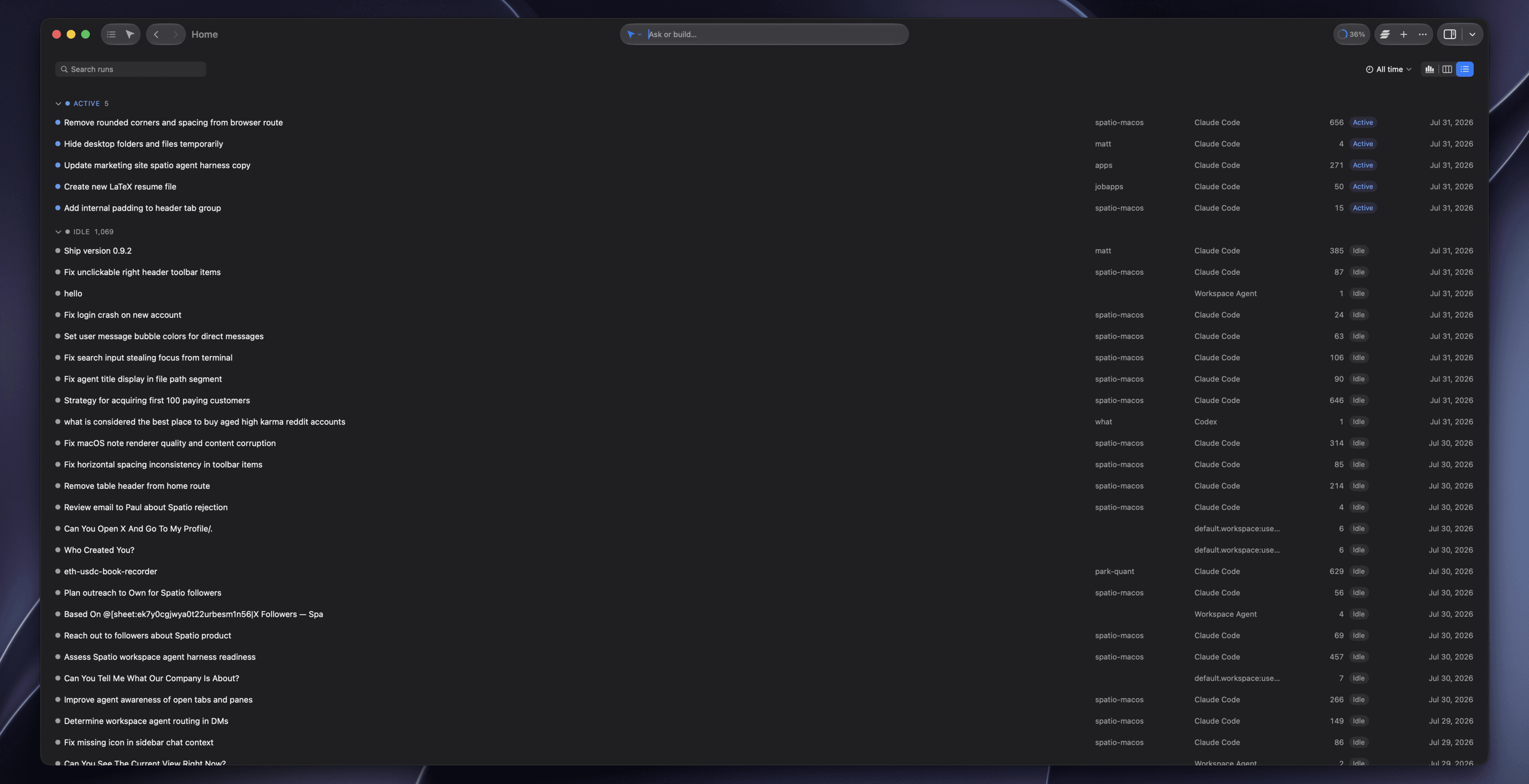
Every artifact in one table
The home view puts your whole workspace in a single dense, sortable table, the view you already think in. Filter, group and scan across every platform at once instead of hopping between apps to find the thing you half-remember.
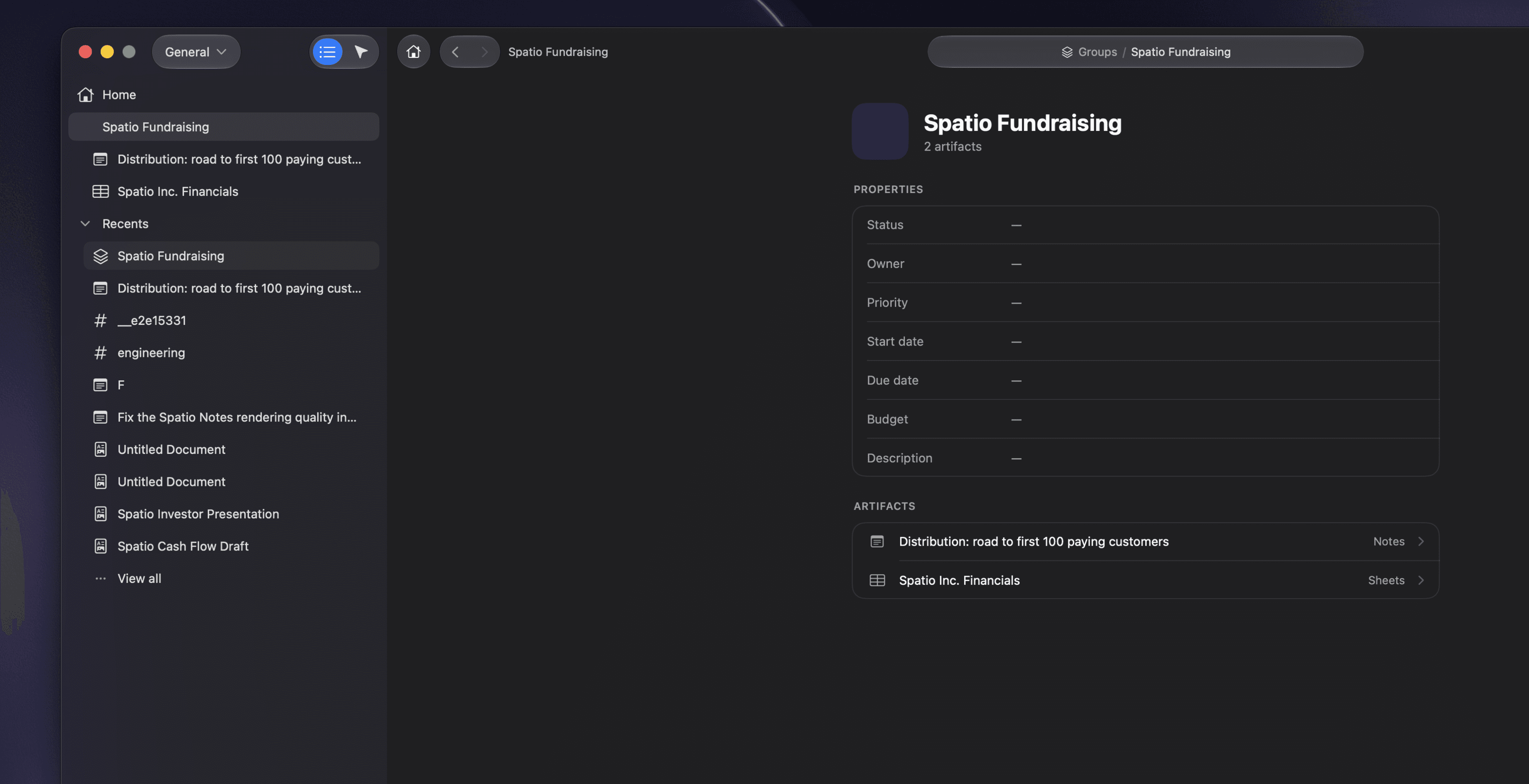
Structure that bends to your team
Groups are a nestable container for any artifact, shipped with opinionated templates that are offered rather than imposed. Strong defaults when you want them, and a structure you can actually reshape when your team does not work the way the tool assumed.
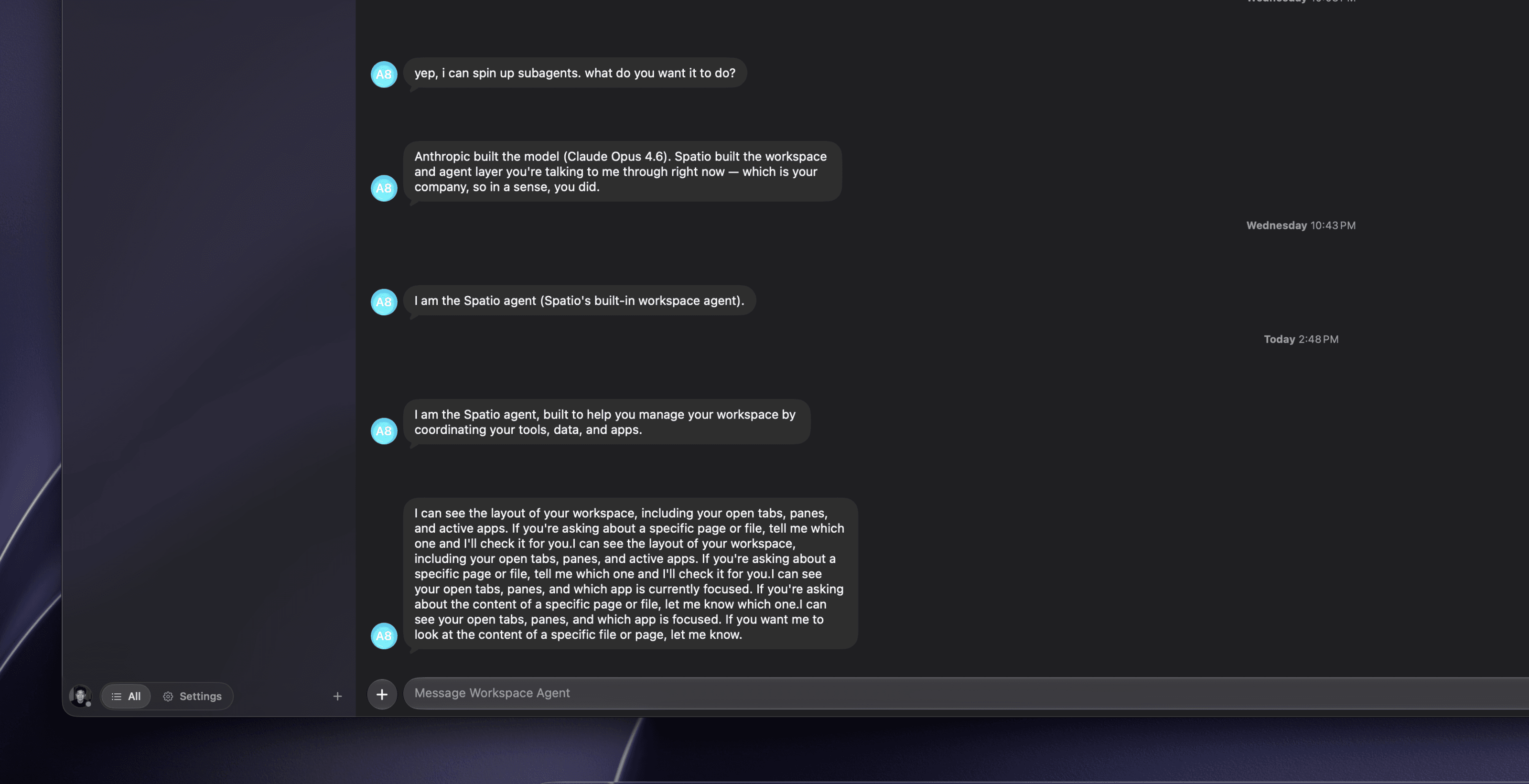
It already knows the context
No re-explaining the project, no pasting the doc back in, no @-mentioning the same six files every session. What you have open travels with the conversation, so you pick up mid-thought instead of spending the first three messages describing your own workspace.
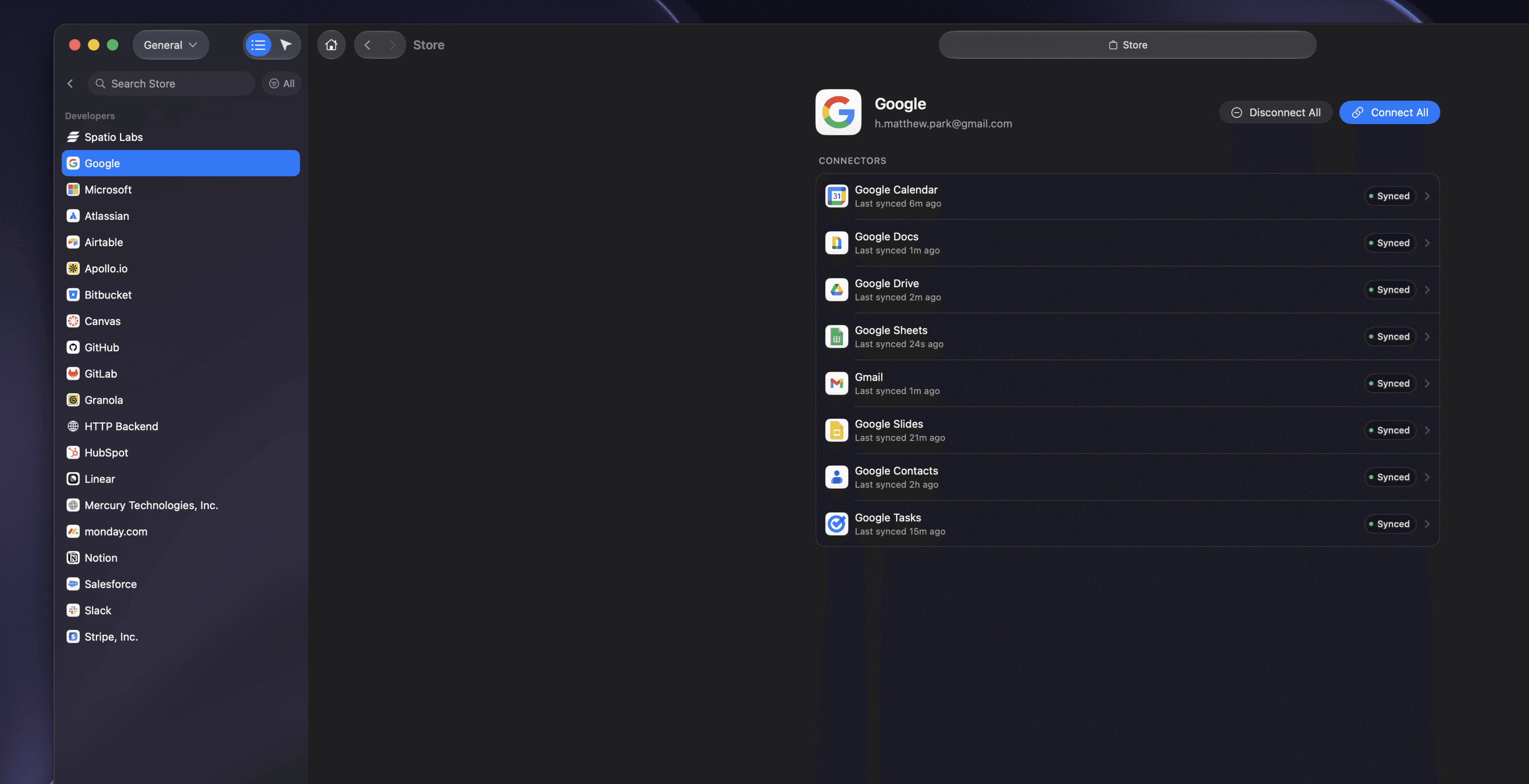
Your data, however it has to be reached
Native providers for the systems we build deep, third-party providers for the long tail, and Spatio Browser for everything with no dependable API. Your agent works in the real account with your real session rather than a stale export.
How work moves through your workspace
Every task takes the same path. Your systems come in once, the agent works against them where they actually live, and what comes out is a record your team can act on. The last stage is why the loop is worth drawing: each pass leaves the workspace knowing more than it did before.
- 01
Connect
OnceYour accounts land in the workspace. Native providers for the systems we build deep, third parties for the long tail, and Spatio Browser for anything with no dependable API.
- 02
Ask
Dispatch from wherever you are: the app, the CLI, or any MCP client. The turn carries your open panes and the artifact in front of you, so you never re-explain the project.
- 03
Act
The harness runs the loop with every workspace tool on the table, executing against the real account rather than describing it. Real engineering hands off to Claude Code or Codex.
- 04
Land
Output arrives as a doc, a sheet, a task, a message or a draft in your voice. A record the rest of the org can open, edit and act on, not a transcript to copy out of.
- 05
Compound
Every pass feeds the org brain: the concepts your team works from, its vocabulary, its voice. It is a file you own, and the next ask starts from what it already knows.
Back to 02. The next ask starts further ahead.
The same agent, in your terminal.
The workspace does not stop at the app. Install the CLI and the agent that runs your docs, tasks, mail and channels is one command away: pipe it your git log, script it in CI, or hand it your inbox from the shell you already live in.
spatio -p "…"One-shot headless runs. Prompt in, streamed reply on stdout, so it composes with pipes and drops straight into scripts and CI.
spatio chatSession-addressable runs. Open a session, send turns, tail the event stream as NDJSON, and pass the session id between processes.
spatio do <action>Every platform action, from the shell. Complete tasks, send mail, create notes. New platforms show up automatically, no CLI update needed.
Install in one command
npm install -g @spatio-labs/cliLive in your terminal
Any MCP client can drive the harness. We ship the ones you will want.
The Spatio Workspace Agent Harness is exposed over MCP, so it is not tied to our app. Point Claude Code, Codex, Cursor or anything else that speaks the protocol at it and the agent gets every tool in your workspace, grounded in your real data.
We also build first-party clients, because most days you do not want to assemble one. Same harness, same workspace, same artifacts, whichever you open.
Desktop
The central hubWhere you do all your work. Augment your agents, open every platform, and watch artifacts come to life at native speed.
CLI
In your terminalDrive your workspace without leaving the shell. Kick off agents, check on runs, and act on results inline.
iMessage
From your phoneText your agent like a teammate. Ask a question, hand off a task, or approve a result straight from Messages.
Any MCP client
Bring your ownClaude Code, Codex, Cursor, or anything else that speaks the protocol. Point it at the harness and it gets the same tools and the same workspace.
Start on your desktop. Continue in the cloud.
Our purpose-built handoff keeps every run alive across surfaces. Work you begin on the desktop continues uninterrupted in the cloud while you’re away, then resumes with full context the moment you return. No re-briefing, no lost progress.